
Crossfade Roulette–My Weekly Music Column
Oscar-Nominated Documentary Shorts 2014
My coverage of the Oscar-nominated documentary shorts 2014
Facing Fear, directed by Jason Cohen
Facing Fear recounts of tale of crossed paths, forgiveness, and reconciliation. Los Angeles’ Museum of Tolerance staffer Matthew Boger meets reformed neo-Nazi Tim Zaal to discuss a talk by Zaal. In the process of comparing notes about their days in LA, when Matthew was a homeless street kid, they realize that Zaal was the neo-Nazi who kicked Matthew in the face and left him for dead. The film is not only an examination of forgiveness, but a rare glimpse into the psychology of hate. “Violence made me feel big, elated. It was like a drug, the adrenaline of it.” And like a drug, it stopped working, Zaal explains. In a particularly poignant scene, he recounts how seeing one of his own kids talking like a racist made him feel profoundly ashamed and disgusted. It was the epiphany that turned him away from the movement he lived in for decades. He is humbled by Matthew’s ability to forgive him and recounts the flip-side as well, which is how difficult it was for him to forgive himself.
Cave Digger, directed by Jeffrey Karoff
There is a fine line between madness and genius, the story goes, and Ra Paulette is the epitome of the ardent, borderline maniacal zeal that burns inside many artists. Ra digs cathedral-like art caves into the sandstone cliffs of New Mexico.The labor is grinding and physically arduous beyond measure: he toils for years on each one. The patrons who commission his work do not share in his obsession and there is ensuing friction, a wry commentary on the push-and-pull between art and business. They want to have input; Ra says he is not a “paintbrush.” Valid points on both ends, indeed. Tired of taking commissions, Ra starts a massive self-funded 10-year cave project. Cave Digger could have been the live action version of the Bhagavad Gita, with Ra’s insistence on not being tied to the results but just enjoying the process of creation.
Karama Has No Walls, directed by Sara Ishaq
In a similar vein to The Square, Karama Has No Walls explores a tragedy that left 53 people dead at Change Square in Yemen’s capital, Sanaa, during the 2011 Arab Spring. The short shines a light on the often-forgotten cost of the peaceful protests. While the protestors themselves were peaceful, they were subjected to incredible violence by a regime refusing to concede defeat. The image of snipers shooting at a crowd from above is a scathing commentary on political oppression and the high cost of liberty.
The Lady In Number 6: Music Saved My Life, directed by Malcolm Clarke
“Music is a dream. Music is God.” The lady is number 6 is Alice Herz Sommer, a 109 year old pianist and Holocaust survivor. A soul-stirring paean to the transformative power of music, the film documents Alice’s unbridled love for it. Her love is unmarred because music literally saved her life as she was spared from the worst fate in the concentration camps (the Nazis exploited her gift). Alice’s natural ebullience make the film thoroughly engrossing.
AND THE WINNER IS…
Facing Fear is the most compelling because of the sheer scope of emotions and human experience it covers: from Matthew’s own feelings about his sexuality, making peace with a family that put him out on the street at 13, and Tim’s acceptance of a life spent living a way that he now finds abhorrent. Facing Fear is true to its title. Skeletons are big and small, monsters hide in the darkest recesses of our hearts, and the ultimate redemption that also lies there as well, if we know how to look for it.
* We were unable to review Prison Terminal: The Last Days of Private Jack Hall.
DC Tattoo Expo 2014
Crossfade Roulette–My Weekly Music Column

The Square Documentary Review
The Square, a documentary by Egyptian-American filmmaker Jehane Noujaim (Control Room) is a heady tour-de-force look at the Arab Spring and its aftermath. Initially covering only Mubarak’s ouster in 2011, Noujaim continued filming throughout the summer and the next tumultuous two years, capturing the the Egyptian Army’s removal of the elected President Mohammad Morsi. The theme of the film is unequivocally revolution, a loaded word that has inched its way towards meaningless and obsolescence, yet here comes roaring into vibrancy. The Square is an engrossing look at the lives of several activists who remain doggedly staunch in their quest for change despite increasingly harrowing circumstances and a constantly changing political landscape. Perhaps surprisingly, the film, while grounded in realism, is unapologetic in its idealism. These activists, although fighting for political change, are actually about as soured on politics and politicians as one can be – the change they seek out and their motivations are universally human and refreshingly not power-centered.
The main character in The Square is “the people,” a word referenced many times and one with an actual significance very unlike the cynical, hollow place it holds in Western parlance. Instead of merely a cheap ploy used by grandiloquent politicians to play upon the emotional heartstrings of a vulnerable public, it is something very much of an undeniable reality. The sight of literally millions of people lining Tahrir Square is moving beyond measure and illustrative of what “we are united,” can precipitate. It’s impossible not to wonder why this has yet to happen in the US and makes palpable to the viewer how a dictator in power for over 30 years can be deposed by a mass protest of such unbridled will.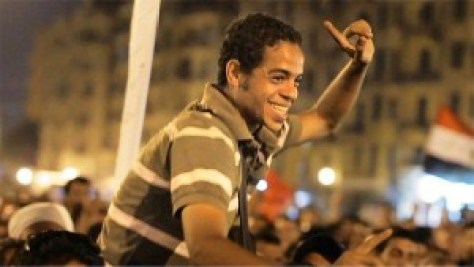
The “star” of the film, if there is one, is 20-something Ahmed Hassan, an impossibly ebullient working-class youth. Facing increasing disillusionment and personal danger, he remains optimistic even as the regimes change but the circumstances of the people do not. The Square eloquently shows how impossibly fraught and elusive that very concept is and how revolution is hard to come by in a world mired in politics. As he poignantly puts it in regard to the Muslim Brotherhood’s maneuvering into power, “while we were dying in the streets, they were making deals.”
The Square also does an excellent job of demystifying the headlines for a Western audience and untangling a very complex political situation without relying on pundits for commentary. Ultimately, it drives home the point that figure heads nary make a country – all the country’s institutions are the regime. It also portrays the strong role that the military plays in Egypt, especially in their ability to turn a revolution into a war, as Ahmed explains. The fact that the protestors all come from really different backgrounds – for example, actor Khaled Abdalla is foreign-born and of an activist background and Magdy is a member of the Muslim Brotherhood – serves to underline that divisions were not present during the initial protests against Mubarak. “We were united…one hand.”
Despite what seems to be a political quagmire with nothing immediately positive to offer to the people of Egypt, The Square will leave you feeling uplifted by what “the people” can do to effect change. Ahmed explains that they, ”created a conscience, not a political force. We created a culture of protesting and gave the people ownership of their freedom.” The Square is really about something fundamental inside people that moves them to fight injustice. Tahrir Square remains a symbolic peace of land not because of what circumstances it brought about but because it showed what a people united can do. While this may sound incredibly simplistic, The Square proves that it is still something that can take place.
Crossfade Roulette–My Weekly Music Column
Old Rivalry, New Age
On December 12, 2013 the World Affairs Council-Washington, DC hosted an event on Russia’s role in the international community entitled “US-Russia Rivalry: Old Rivalry, New Age?” moderated by Anya Schmemann and featuring Dr. Fiona Hill of Brookings and Dr. Donald Jensen. Four years later, the reset in U.S.-Russian relations has been reset many times over to a much icier territory with issues like Russia’s support for Syria and a crackdown on opposition creating an increasingly tense atmosphere. Ms. Schmemann began by posing the question of how the U.S. should view Russia, in light of the American media’s frequent portrayal of Russia as a rather recalcitrant rival. Dr. Jensen responded that Russia’s primary goal is to reassert itself as a great power. “Russia is neither a friend nor an enemy, but it is not a partner either. It is a country we can cooperate with on issues of common interest.” Russia often defines itself by taking the “non-American position,” he continued. Russia respects strength and this makes the task of diplomacy very complicated but not impossible. “While they respect the U.S., they have taken the measure of the man and feel they can maneuver the U.S. in positions to Russia’s advantage. The national security/great power preoccupation of the Kremlin parallels the realist approach of many U.S. foreigner affairs thinkers so in a sense there is a natural fit between the two countries’ agendas, but there is also a disconnect.”
The discussion then turned to Russian domestic affairs and how much influence, if any, the United States has on them. Dr. Hill believes that that influence is little if not entirely none. “What we have with Putin is that the Russian political system is highly personalized, somewhat of a “one boy” network—everyone at the top is in one way or another related to Putin. There is a very tight web of informal networks.” While Dr. Jensen agreed with this, a small point of contention was on whether there is a growing ideological divide between the U.S. and Russia. Dr. Hill believes that Putin is promoting a return to traditional family values. She noted that Putin’s recent poslanie was very much an indication of the conservative direction in which Russia is moving. “In his poslanie, Putin very much admitted he is a conservative politician who believes in a conservative agenda to move the country forward. That means an anti-Western, anti-individualist, communitarian point of view with a strong role for the Russian Orthodox Church.” Dr. Hill suggested that Putin has been contextualizing Russia as an unique civilization in his speeches—and that a return to traditional Russian Orthodox family values is what would move the country forward. “The Russian Orthodox Church has proven to still be an entity that can mobilize hundreds thousands of people on the streets. In a place that still has a great deal of discomfort with same sex relations, Putin is, in a sense, expressing what is already in place and reaching out to other European countries with similarly conservative stances.” Dr. Hill suggested that this new ideological stance, which Dr. Jensen does not believe is present, is a stand that is a reaction against the decadence of the West and that Sochi is a battleground of sorts for this ideological divide.
Dr. Hill identified three trends in place in Russia that are affecting domestic affairs at the moment. First, the Russian economy has slowed down. For over 10 years, the Russian economy has been growing at 7-8 percent, creating a lot of expectations for the continuation of this burgeoning; these expectations now have to be seriously tempered in view of the current 1-2% rate growth. Russia is across the board a commodities and natural resource-based economy, Dr. Hill suggested. This also makes Russia very vulnerable to commodity price fluctuations. The big problem is moving into “value added products.” “Putin keeps laying out that Russia wants to diversify its economy, but they cannot do that, in fact, it would be foolish to do so as this is not their comparative or competitive advantage. All that would happen would be to subsidize industries that would not have a long term success.” Russia’s trade relations tend to be dominated by energy and there is growing concern that the Gasprom-model is changing and grinding down, which is why the thrust is moving away from Europe and courting China. Dr. Hill pointed to the armaments industry as still one of Russia’s most vibrant manufacturing sectors. “7 million people still depend on the industry for jobs. This is why we see Putin really trying to push this forward and find more buyers for Russia’s arms. He addressed this in the poslanie—in a sense, making himself personally responsible for finding markets to sell these products.”
The second trend is the rise of Russian nationalism–anti-immigrant and anti-migrant sentiments are taking hold, much as they are in the rest of Europe. The anti-migrant feeling is also directed towards people moving into Moscow from other cities, more specifically toward the Muslim population from the Northern Caucus area. The third trend is the decline of Putin’s popularity. Dr. Hill stated that Putin’s approval ratings have plunged from the high marks of 80% to 60% to now as low as 40% in terms of actual voter turnout strength. Both panelists opined that Putin’s tightening of power is spurred by fear of rivals and insecurity. Dr. Hill asked the question of whether it is possible to have Putinism without Putin. She suggested that a political re-entrenchment is taking place to put the political instruments in place for the successful continuation of the system. The highly-personalized/charismatic leader model of the Russian political system necessitates that public approval does not ebb as this is what bestows the leader legitimacy, she added.
Crossfade Roulette–My Weekly Music Column
Dirty Wars Film Blurb
Blurb on the film Dirty Wars for BYT’s Top 13 Movie Superlatives of 2013
Jeremy Scahill, a veteran war journalist and the national security correspondent for The Nation, shines a light on the shadowy outfit known as JSOC, Joint Special Operations Command, better known as the people who killed Osama bin Laden in this especially timely and weighty documentary, with the recent controversy over the drone program. JSOC, in place for decades, was created to essentially function outside the purview of any legal or military rule, but Dirty Wars makes a strong and shocking case for it reaching the apogee of its power during Obama’s terms, enjoying a level of impunity unheard of before, targeting assumed terrorists, launching drone attacks, and killing innocent civilians in countries with which the US is not even officially militarily engaged. Having chanced upon the very concept of JSOC in 2010, Scahill is stunned to see it come defiantly into the spotlight, taking credit for bin Laden’s capture, and turning its previously-camera-shy commanders into heroes. Ultimately, Dirty Wars, as the title indicates is about global war being waged in the name of national security by an organization with almost no accountability, except to the President, and one prone to night raids and “kill lists” without regard to nationality or legality. This was the case with American-born Islamic cleric Anwar al-Awlaki and his 16-year-old son, Abdulrahman al-Awlaki, who were both killed by drones. Dirty Wars is the grotesque flipside of Zero Dark Thirty: piles of bodies do nothing to make this kind of warfare seem just and blow the concept of “collateral damage” to smithereens.